
Many English learners and even native speakers often get confused about the difference between affect and effect. Since both words have similar spelling and pronunciation, they are commonly misused in writing and conversation.
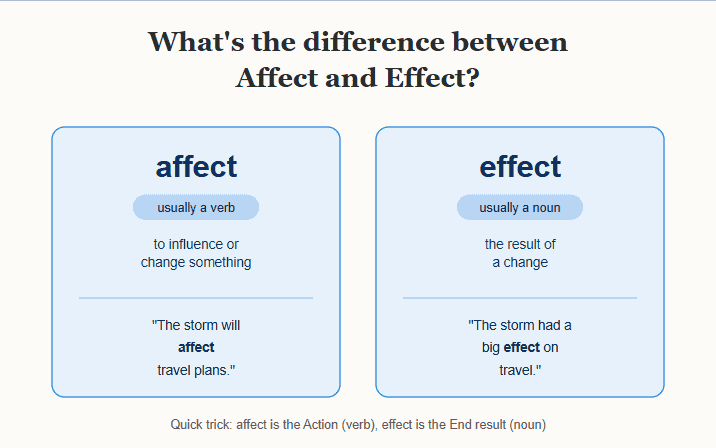
The easiest way to remember them is that affect is usually a verb (an action), while effect is usually a noun (a result). Once you understand this simple rule, choosing the correct word becomes much easier.
What Is Affect?
Affect is most commonly used as a verb that means to influence, change, or have an impact on someone or something.
Examples
- Lack of sleep can affect your concentration.
- Weather conditions affect crop production.
- Positive feedback can affect employee motivation.
In each example, affect describes an action that changes or influences something else.
What Is Effect?
Effect is most commonly used as a noun, meaning the result or outcome of an action.
Examples
- The new policy had a significant positive effect on overall productivity.
- Exercise has a beneficial effect on mental health.
- One effect of heavy rain is flooding.
Here, effect refers to the result that follows an action or event.
What’s the Difference Between Affect and Effect?
The main difference lies in their grammatical roles.
| Affect | Effect |
| Usually a verb | Usually a noun |
| Means to influence or change | Means the result or outcome |
| Describes an action | Describes what happens because of that action |
Simple Example
- Stress can affect your health.
- The effect of stress can include headaches and fatigue.
The first sentence explains the action, while the second describes the result.
Easy Trick to Remember
A simple memory tip can help you avoid confusion:
- Affect = Action (both start with A)
- Effect = End Result (both start with E)
Whenever you’re talking about influencing something, use affect. If you’re talking about the outcome, use effect.
Common Mistakes
Here are a few examples of correct and incorrect usage of affect and effect.
Incorrect: The weather had a bad affect on our trip.
Correct: The weather had a bad effect on our trip.
Incorrect: Loud music can effect your hearing.
Correct: Loud music can affect your hearing.
Checking whether you are describing an action or a result is often enough to choose the correct word.
Be aware: Font vs Typeface
Be aware: Best Online Grammar Checkers
Can Effect Be a Verb?
Yes, but this usage is less common.
In its verb form, effect means to make something happen or successfully bring about a desired change.
Example
- The new manager hopes to effect positive change within the company.
In everyday English, however, you’ll mostly see effect used as a noun.
Can Affect Be a Noun?
Yes, but this meaning is mainly used in psychology and medicine.
For example:
- The patient displayed a flat affect during the interview.
In general writing and conversation, affect is almost always used as a verb.
Practice Sentences
Try filling in the blanks.
- Lack of exercise can _____ your energy levels.
- The medicine had an immediate _____ on the patient’s condition.
- Social media can _____ the way people communicate.
- The new law had a significant _____ on businesses.
Answers
- affect
- effect
- affect
- effect
Why Knowing the Difference Matters
Using the correct word makes your writing clearer and more professional. Whether you’re writing emails, academic papers, blog posts, or social media content, understanding the difference between affect and effect helps you communicate more accurately. If you’re also improving your English skills, exploring the best language exchange apps can help you practice grammar naturally through real conversations.
Frequently Asked Questions
Is affect always a verb?
Most of the time, yes. Although it can be a noun in psychology, it is generally used as a verb meaning “to influence.”
Is effect always a noun?
Usually, yes. It refers to the result of an action. Although effect is usually a noun, it can also function as a verb, meaning to accomplish or bring about a result.
How do I remember affect vs. effect?
Remember this simple rule:
- Affect = Action
- Effect = End Result
This trick works for most everyday situations.
Conclusion
If you’ve ever wondered what the difference is between affect and effect, the answer is simple. Affect usually means to influence and functions as a verb, while effect usually means the result and functions as a noun. Keeping this distinction in mind will help you write with greater confidence and avoid one of the most common grammar mistakes in English. To further improve your grammar and writing skills, you can also use SEOToolzz.com, which offers a variety of free writing and language tools to help you write more accurately and confidently.
