
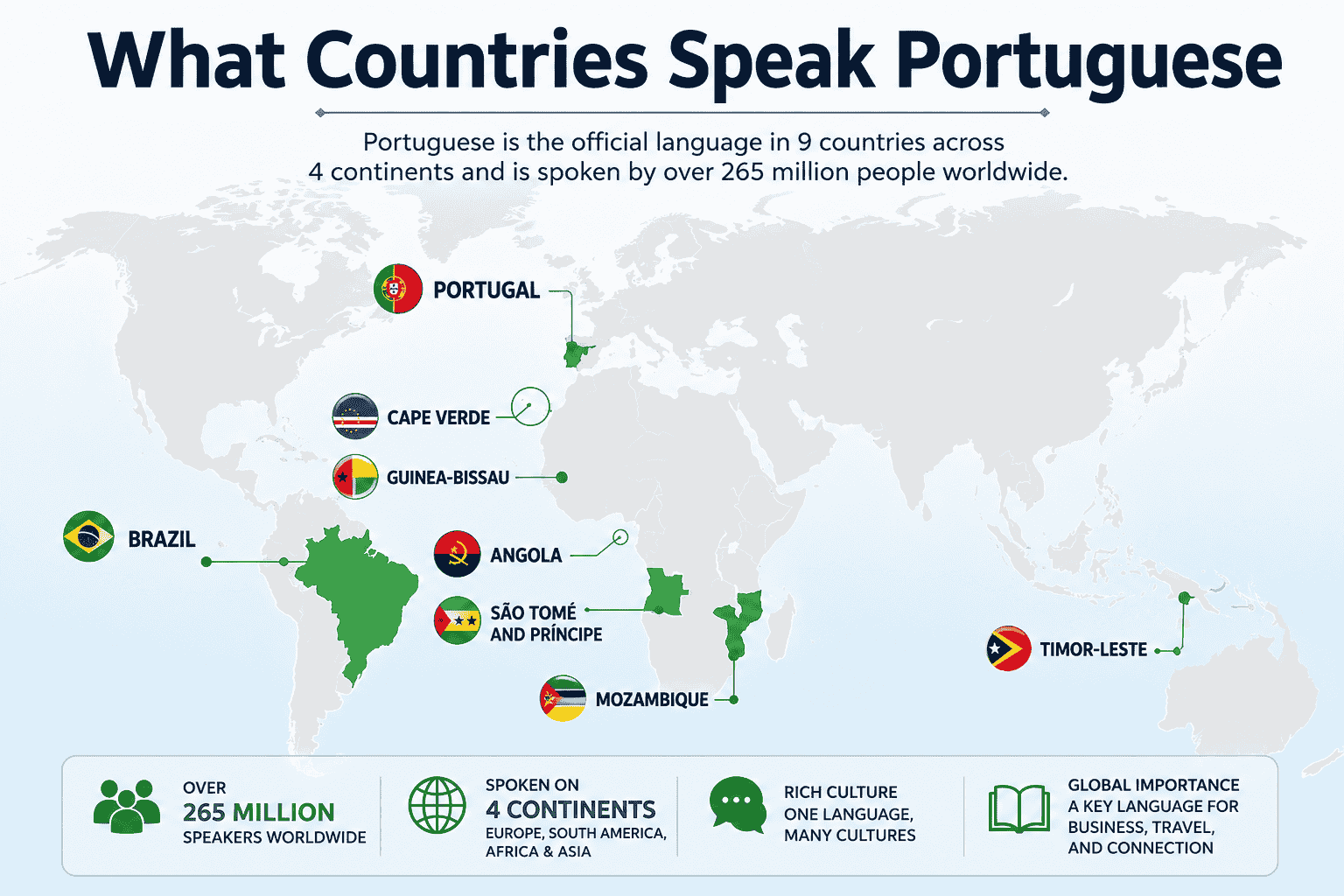
Portuguese is one of the most widely spoken languages in the world, with more than 265 million speakers across multiple continents. Although many people associate Portuguese only with Portugal and Brazil, it is also the official language of several countries in Africa and Asia.
In this guide, you’ll learn what countries speak Portuguese, where the language is officially recognized, and why it continues to grow globally.
What Countries Speak Portuguese?
Portuguese is the official language of nine sovereign countries and one special administrative region. These countries together form the Community of Portuguese Language Countries (CPLP).
| Country | Continent | Portuguese Status | Estimated Speakers |
| Brazil | South America | Official Language | 215+ million |
| Portugal | Europe | Official Language | 10+ million |
| Angola | Africa | Official Language | 35+ million |
| Mozambique | Africa | Official Language | 33+ million |
| Guinea-Bissau | Africa | Official Language | 2 million |
| Cape Verde | Africa | Official Language | 600,000+ |
| São Tomé and Príncipe | Africa | Official Language | 230,000+ |
| East Timor (Timor-Leste) | Asia | Official Language | 1.4 million |
| Equatorial Guinea | Africa | Official Language | 1.7 million |
Brazil
Brazil is home to the world’s largest Portuguese-speaking population, with more than 215 million people using Portuguese as their primary language. More than 80% of all Portuguese speakers live in Brazil.
Brazilian Portuguese differs from European Portuguese in pronunciation, vocabulary, and spelling, but both varieties remain mutually understandable.
Portugal
Portugal is the birthplace of the Portuguese language. The language originated here during the Middle Ages before spreading worldwide through Portuguese exploration.
European Portuguese is considered the standard form taught in many language schools across Europe.
Angola
Portuguese is Angola’s official language and is widely used in government, education, media, and business. The number of native Portuguese speakers continues to grow, especially in urban areas.
Mozambique
Mozambique uses Portuguese as its official language despite having many indigenous languages. Portuguese serves as a common language that connects different ethnic groups throughout the country.
Guinea-Bissau
Although several local languages are spoken daily, Portuguese remains the official language used in schools, courts, and government institutions.
Cape Verde
Cape Verde officially uses Portuguese, while many residents also speak Cape Verdean Creole in everyday conversations. Portuguese remains the primary language for education and official communication.
São Tomé and Príncipe
Throughout São Tomé and Príncipe, Portuguese is the primary language used in everyday life, education, government, and the media. It is used in government, education, television, newspapers, and business.
East Timor (Timor-Leste)
Located in Southeast Asia, East Timor recognizes Portuguese and Tetum as its official languages. Portuguese plays an important role in education and legal affairs.
Equatorial Guinea
Equatorial Guinea adopted Portuguese as an official language in 2010 to strengthen ties with Portuguese-speaking nations. Although Spanish is the most widely spoken language in Equatorial Guinea, Portuguese is also recognized as an official language.
Other Places Where Portuguese Is Spoken
Portuguese is also spoken in several regions and communities outside the official Portuguese-speaking countries.
These include:
- Macau (China)
- Goa (India)
- Luxembourg
- United States
- Canada
- France
- Switzerland
- United Kingdom
Many of these communities consist of Portuguese and Brazilian immigrants who continue using the language in daily life.
Portuguese-Speaking Countries by Continent
| Continent | Countries |
| Europe | Portugal |
| South America | Brazil |
| Africa | Angola, Mozambique, Guinea-Bissau, Cape Verde, São Tomé and Príncipe, Equatorial Guinea |
| Asia | East Timor |
Why Is Portuguese Spoken in So Many Countries?
Portuguese spread across the world during the Age of Exploration in the 15th and 16th centuries. Portuguese explorers established colonies in South America, Africa, and Asia, where the language became part of government, education, trade, and culture.
Even after these countries gained independence, many retained Portuguese as their official language because it served as a common means of communication among diverse populations.
Is Portuguese the Same Everywhere?
No. Portuguese has several regional varieties.
The two most widely recognized forms are:
- Brazilian Portuguese
- European Portuguese
Other countries also have unique accents and vocabulary, but all forms share the same grammatical foundation, making communication relatively easy among speakers.
Frequently Asked Questions
How many countries officially speak Portuguese?
Portuguese is the official language of nine independent countries spanning Europe, South America, Africa, and Asia.
Which country has the most Portuguese speakers?
Brazil has the largest Portuguese-speaking population, with over 215 million speakers.
Is Portuguese spoken only in Europe and South America?
No. Portuguese is also widely spoken in Africa and Asia.
Is Portuguese difficult to learn?
For English and Spanish speakers, Portuguese is considered moderately easy because of its shared Latin roots and similar vocabulary.
Which Portuguese should I learn?
Brazilian Portuguese has the largest number of speakers, whereas European Portuguese is ideal for those planning to live, study, or work in Portugal.
Final Words
If you’ve ever wondered what countries speak Portuguese, the answer extends far beyond Portugal. Portuguese is the official language of Brazil, Portugal, Angola, Mozambique, Guinea-Bissau, Cape Verde, São Tomé and Príncipe, East Timor, and Equatorial Guinea, making it one of the world’s most influential languages.
Whether you’re learning Portuguese for travel, work, or personal growth, understanding where it is spoken can help you choose the right dialect and learning resources. Pairing your studies with the Best Language Exchange Apps is an effective way to practice with native speakers and build confidence in real conversations.
