
The term AD is widely used in history, education, business, technology, advertising, and digital communication. Many people search for what does AD stand for because the abbreviation has multiple meanings depending on the context. In historical timelines, AD refers to years after the birth of Jesus Christ, while in marketing and business, it often means advertisement.
Understanding the correct meaning of AD helps avoid confusion and improves communication in academic, professional, and everyday situations. In this complete guide, we will explain the meaning of AD, its historical origin, modern uses, examples, and differences from similar abbreviations.
What Does AD Stand For in History?
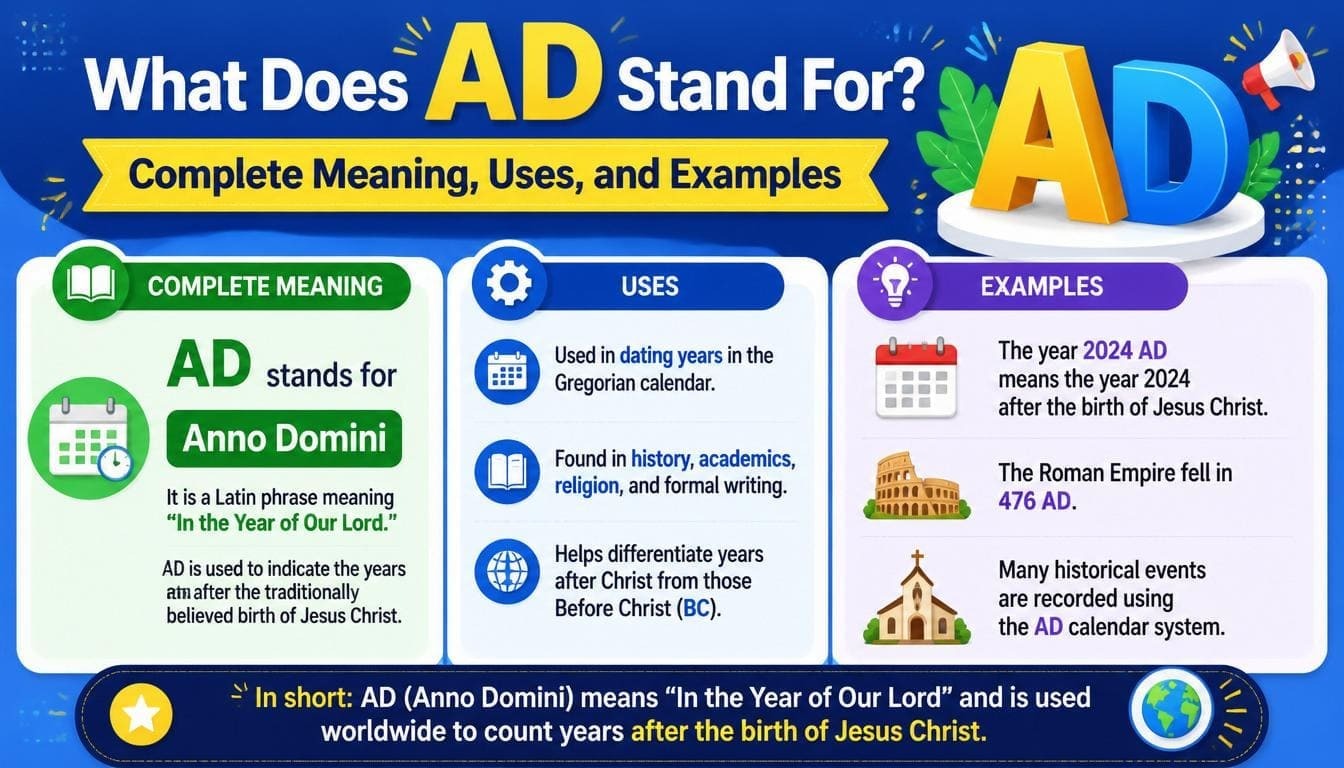
In historical and calendar contexts, AD stands for “Anno Domini.” This is a Latin phrase that means “In the Year of Our Lord.”
It is used to label years after the birth of Jesus Christ in the Gregorian and Julian calendar systems.
Example of AD in Dates
- 476 AD
- 1492 AD
- 2026 AD
When we say “500 AD,” it means 500 years after the birth of Jesus Christ according to the traditional calendar system.
Origin of AD
The AD dating system was introduced by a Christian monk named Dionysius Exiguus in the 6th century. The purpose was to create a calendar centered around the birth of Jesus Christ rather than using older Roman dating systems.
Over time, this system became widely accepted across Europe and eventually around the world.
How AD Is Written Correctly
Unlike some abbreviations, AD is traditionally written before the year number.
Correct Examples
- AD 2026
- AD 500
- AD 1200
However, in modern writing, many people also place it after the year informally.
Difference Between AD and BC
AD and BC are commonly used together in historical timelines.
| Term | Full Form | Meaning |
| AD | Anno Domini | Years after the birth of Jesus Christ |
| BC | Before Christ | Years before the birth of Jesus Christ |
Example Timeline
- 300 BC = 300 years before Christ
- AD 300 = 300 years after Christ
There is no year zero between BC and AD.
Modern Alternative to AD
Today, many academic institutions use alternative terms:
| Traditional Term | Modern Alternative |
| AD | CE (Common Era) |
| BC | BCE (Before Common Era) |
The numbering system remains the same.
Example
- AD 2026 = CE 2026
These alternatives are used to create a more culturally neutral dating system.
What Does AD Stand For in Advertising?
In business and marketing, AD commonly stands for Advertisement.
Advertisements are promotional messages designed to market products, services, or brands.
Examples of Advertising ADs
- Social media ads
- TV commercials
- YouTube ads
- Google ads
- Newspaper advertisements
Advertising plays a major role in digital marketing and brand promotion.
Types of Advertising Ads
Advertising has evolved significantly with technology.
Digital Ads
Online advertisements shown on:
- Websites
- Search engines
- Social media platforms
- Mobile apps
Print Ads
Traditional ads found in:
- Newspapers
- Magazines
- Brochures
Video Ads
Promotional videos displayed on:
- Television
- Streaming platforms
- Video-sharing websites
What Does AD Mean in Technology?
In technology and computer networking, AD may stand for Active Directory.
What Is Active Directory?
Active Directory is a directory service developed by Microsoft for managing users, computers, and network resources.
It is widely used in:
- Corporate IT systems
- Enterprise networks
- User authentication
- Security management
What Does AD Mean in Medical Terms?
In medical and scientific fields, AD can have several meanings depending on the context.
Examples
- Alzheimer’s Disease
- Atopic Dermatitis
- Right Ear (Auris Dextra in Latin)
Medical abbreviations should always be interpreted carefully because meanings vary across specialties.
Common Uses of AD in Daily Life
The abbreviation AD appears in many areas of daily communication.
Education
Students learn AD while studying:
- History
- Ancient civilizations
- Historical timelines
Marketing
Businesses use ads for:
- Product promotion
- Brand awareness
- Customer engagement
Technology
IT professionals use AD in network administration and security management.
Why Understanding AD Is Important
Knowing the correct meaning of AD helps improve understanding in different fields.
Benefits of Understanding AD
- Improves historical knowledge
- Helps interpret timelines correctly
- Enhances communication in business
- Prevents misunderstanding in technical discussions
Because AD has multiple meanings, context is extremely important.
Examples of AD in Sentences
Historical Use
- The Roman Empire declined in AD 476.
- Many important events happened during the early AD centuries.
Advertising Use
- The company launched a new ad campaign.
- Social media ads help businesses reach more customers.
Technology Use
- The IT department manages accounts through Active Directory.
Common Confusion About AD
Many people misunderstand AD because they think it means “After Death.” This is incorrect.
Correct Meaning
AD means:
- Anno Domini
- “In the Year of Our Lord”
It does not mean:
- After Death
This misconception is very common among beginners learning historical timelines.
How AD Is Used in Academic Writing
In modern academic writing:
- Historians may use AD and BC
- Some institutions prefer CE and BCE
Both systems refer to the same timeline.
AD in Digital Marketing
The word “ad” is now strongly associated with online advertising.
Popular Digital Ad Platforms
- Google Ads
- Meta Ads
- TikTok Ads
- YouTube Ads
Businesses use these platforms to:
- Increase website traffic
- Generate leads
- Boost sales
- Build brand awareness
Difference Between Ad and Add
People often confuse “ad” and “add.”
| Word | Meaning |
| Ad | Short form of advertisement |
| Add | To include or combine something |
Examples
- I saw an ad online.
- Please add sugar to the tea.
Understanding the difference in spelling is important in writing.
Learning Abbreviations and Full Forms
Learning common abbreviations improves vocabulary and communication skills. Many students and professionals search for resources like the top 100 important full forms to better understand commonly used short forms in education, business, and technology.
Interesting Facts About AD
AD Covers Modern History
Everything after the birth of Jesus Christ is considered part of the AD timeline.
AD Is Used Worldwide
Even countries with diverse cultures and religions widely use the Gregorian calendar.
The Calendar System Evolved Over Centuries
The modern calendar has undergone several adjustments and refinements over the years.
Most Similar:
TBH Meaning in Text
FYI Meaning
YOLO Full Form in Chat
TIA Full Form in Chat
Full form of FR – For Real
Conclusion
Understanding what AD stands for is important because the abbreviation has multiple meanings across different fields. In history, AD stands for Anno Domini, meaning “In the Year of Our Lord,” and is used for years after the birth of Jesus Christ. In business and marketing, AD commonly refers to advertising, while in technology, it may refer to Active Directory.
The correct meaning always depends on context. Whether studying history, working in digital marketing, or managing IT systems, knowing the different uses of AD helps improve communication and understanding.
As language, technology, and education continue evolving, abbreviations like AD remain an important part of modern communication.
Frequently Asked Questions
What does AD stand for in history?
AD stands for Anno Domini, a Latin phrase meaning “In the Year of Our Lord.”
Does AD mean after death?
No, AD does not mean after death. That is a common misconception.
What does AD mean in advertising?
In marketing, AD stands for advertising or advertising content.
What is the difference between AD and BC?
BC refers to years before Christ, while AD refers to years after the birth of Jesus Christ.
What is the modern alternative to AD?
The modern alternative is CE, which stands for Common Era.
