
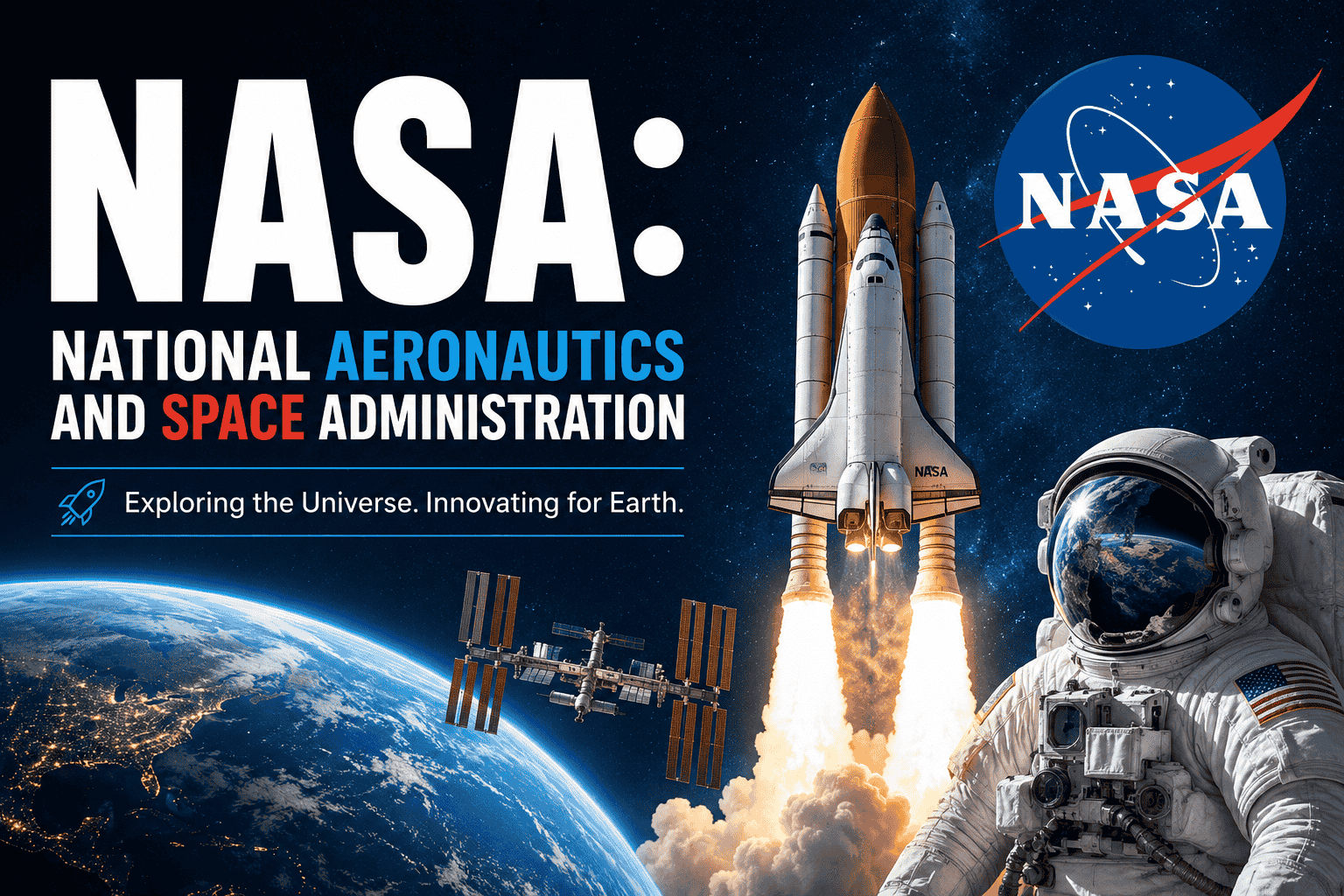
If you’ve ever wondered what does NASA stand for, you’re not alone. NASA is one of the most recognized organizations in the world, known for its groundbreaking space missions, scientific discoveries, and technological innovations. From sending astronauts to the Moon to exploring distant planets, NASA has played a major role in expanding our understanding of the universe.
In this guide, we’ll explain the full form of NASA, its history, mission, achievements, and why it continues to shape the future of space exploration.
What Does NASA Stand For?
NASA stands for the National Aeronautics and Space Administration. It is an independent agency of the United States federal government responsible for the nation’s civilian space program, aeronautics research, and space science.
NASA officially began operations on October 1, 1958, following the signing of the National Aeronautics and Space Act. The agency was established during the Space Race to strengthen the United States’ efforts in space exploration and scientific research.
Breaking Down the Meaning of NASA
Understanding each word in NASA’s full form makes its purpose much clearer.
National
The agency serves the interests of the United States by advancing science, technology, and innovation.
Aeronautics
Aeronautics refers to the study, design, and operation of aircraft within Earth’s atmosphere. Before focusing heavily on space exploration, NASA also conducted extensive research to improve aviation safety and efficiency.
Space
Space represents the exploration of Earth’s orbit, the Moon, Mars, distant planets, asteroids, and the vast universe beyond.
Administration
This indicates that NASA is a government agency responsible for planning, managing, and overseeing national programs related to aeronautics and space exploration.
Why Was NASA Created?
NASA was established to lead peaceful exploration of space and develop advanced aerospace technologies.
Its primary goals include:
- Conducting scientific research
- Exploring space beyond Earth
- Developing innovative aerospace technologies
- Improving aviation systems
- Studying Earth’s climate and environment
- Supporting future human space missions
These objectives continue to guide NASA’s work decades after its creation.
What Does NASA Do Today?
NASA’s responsibilities extend far beyond sending astronauts into space.
Today, the agency focuses on multiple scientific and engineering fields.
Human Space Exploration
NASA trains astronauts and develops spacecraft designed for missions to the Moon, Mars, and beyond. Modern exploration programs aim to establish a sustainable human presence in deep space.
Planetary Exploration
Robotic spacecraft explore planets, moons, asteroids, and comets to gather scientific data and search for signs of past or present life.
Earth Science
NASA operates satellites that monitor Earth’s weather, oceans, forests, atmosphere, and changing climate. These observations help scientists better understand natural disasters and environmental changes.
Space Technology Development
The agency designs advanced propulsion systems, robotics, communication technologies, and spacecraft that benefit both space exploration and life on Earth.
Aeronautics Research
NASA continues to improve aircraft efficiency, safety, and environmental sustainability through cutting-edge aviation research.
NASA’s Most Famous Missions
NASA has completed hundreds of successful missions. Some of the most influential include:
Apollo 11
Apollo 11 became the first mission to land humans on the Moon in 1969, marking one of humanity’s greatest achievements.
Hubble Space Telescope
The Hubble Space Telescope has captured breathtaking images of galaxies, nebulae, and distant stars while helping scientists better understand the universe.
Mars Rover Missions
NASA’s Mars rovers have explored the Martian surface for decades, collecting samples, analyzing rocks, and searching for evidence of ancient water.
Voyager Program
The Voyager spacecraft continues traveling beyond our solar system, carrying information about Earth into interstellar space.
Artemis Program
NASA’s Artemis program aims to return astronauts to the Moon while preparing for future human missions to Mars.
Quick Note: If you’ve recently searched for top 100 important full forms like tbh meaning, AD or am meaning, you’re not alone. Like NASA’s full form, understanding common abbreviations helps make communication and knowledge more accessible.
Why NASA Is Important
NASA represents humanity’s desire to explore the unknown. Every mission expands scientific knowledge while inspiring future generations of engineers, astronauts, and researchers.
The agency’s work improves our understanding of Earth, protects our planet through satellite monitoring, and drives technological innovation that benefits industries worldwide.
As space exploration advances, NASA remains one of the leading organizations shaping the future of science and discovery.
Common Questions About NASA
Is NASA only responsible for space missions?
No. NASA also conducts aeronautics research, Earth science studies, climate monitoring, and technology development.
Is NASA a military organization?
No. NASA is a civilian government agency focused on peaceful scientific research and exploration.
Can ordinary people work at NASA?
Yes. NASA hires engineers, scientists, medical professionals, software developers, educators, researchers, technicians, and many other specialists.
Does NASA work with other countries?
Yes. NASA frequently collaborates with international partners on scientific research and space exploration projects.
