
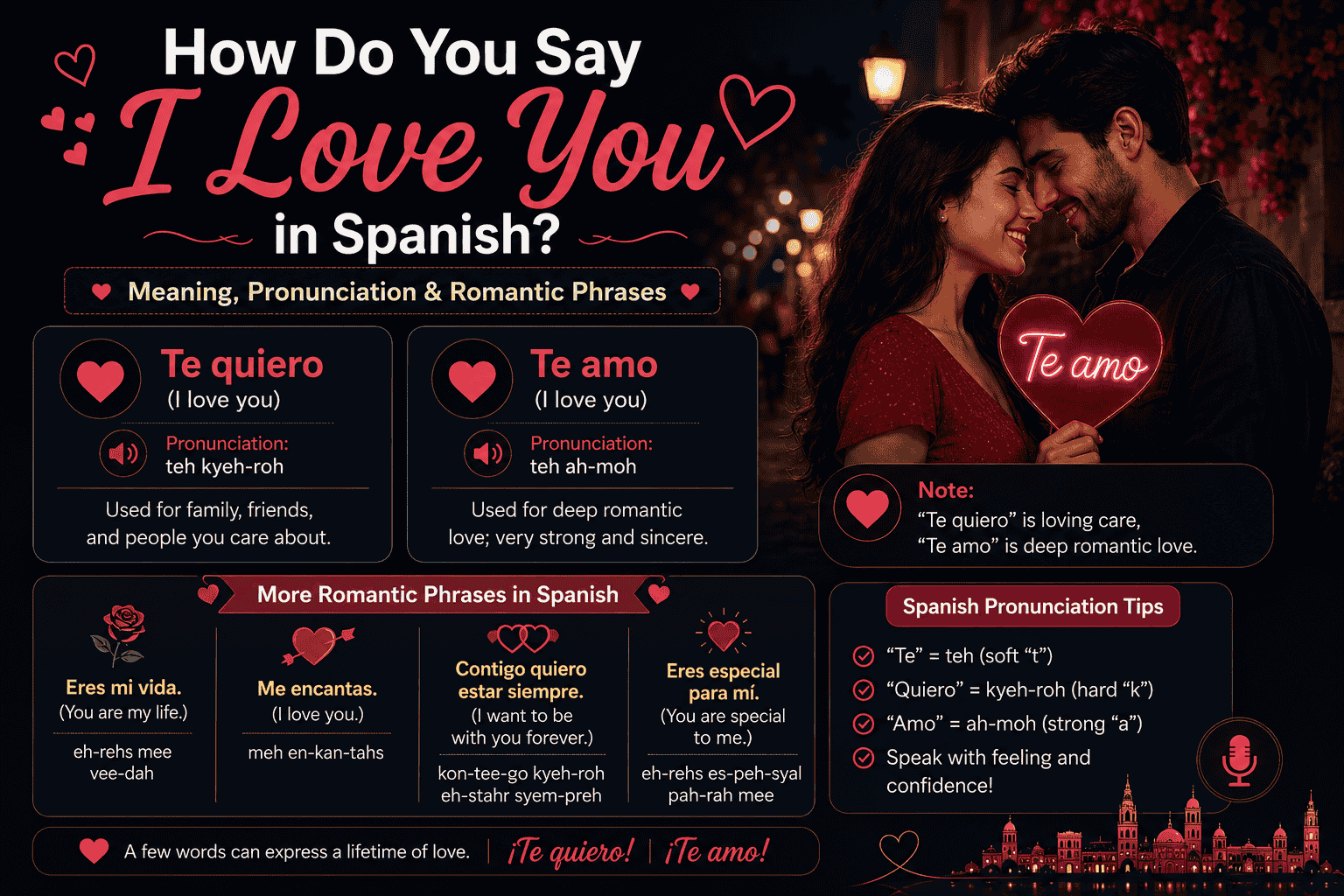
Saying “I love you” in Spanish is one of the most beautiful ways to express your feelings. Whether you’re talking to your partner, spouse, family member, or close friend, Spanish offers different expressions depending on the depth of your emotions. In this guide, you’ll learn how do you say I love you in Spanish, when to use each phrase, and common romantic expressions used by native speakers.
How Do You Say I Love You in Spanish?
The most common way to say I love you in Spanish is:
- Te amo – I love you (deep, romantic love)
- Te quiero – I love you OR I care about you (more versatile)
Both phrases translate to “I love you,” but they are used in different situations.
| Spanish Phrase | English Meaning | Best Used For |
| Te amo | I love you | Romantic partners, spouse |
| Te quiero | I love you / I care about you | Partner, family, close friends |
How to Say I Love You in Spanish Naturally
In Spanish, you can say “I love you” as “Te quiero” or “Te amo.” Which one you use depends on how deeply you feel and who you’re speaking to. If you’re wondering how to say I love you in Spanish like a native speaker, understanding the context is important.
Te Amo
This phrase expresses deep and passionate love. It is commonly used between married couples, long-term partners, or during heartfelt romantic moments.
Example:
- Te amo con todo mi corazón. (I love you with all my heart.)
Te Quiero
Although it literally means “I want you,” its actual meaning is “I love you” or “I care about you.” Native Spanish speakers use it much more frequently in daily conversations.
Example:
- Te quiero mucho. (I love you very much.)
What Is I Love You in Spanish?
If someone asks, what is I love you in Spanish, the answer depends on the relationship.
- Te amo for deep romantic love.
- Te quiero for everyday affection between loved ones.
Neither phrase is more correct than the other; they simply express different levels of emotion.
I Love You Too in Spanish
When someone says “Te amo” or “Te quiero,” you can reply with:
- Yo también te amo. (I love you too.)
- Yo también te quiero. (I love you too.)
The word “también” means “too” or “also.”
Love in Spanish Language: Common Romantic Words
Besides saying “I love you,” there are many affectionate words used in Spanish for love.
| Spanish | English |
| Amor | Love |
| Mi amor | My love |
| Cariño | Darling |
| Corazón | Sweetheart |
| Mi vida | My life |
| Beso | Kiss |
These words are often combined with Te quiero or Te amo to sound even more affectionate.
Mi Amor Artinya
Many people search for Mi Amor Artinya because “artinya” means “meaning” in Indonesian.
Mi amor translates to “My love.”
It is a romantic nickname commonly used between couples, although parents may also use it affectionately for their children.
Examples:
- Hola, mi amor. (Hello, my love.)
- Buenas noches, mi amor. (Good night, my love.)
Other Romantic Spanish Phrases
Here are a few expressions you can use to sound more natural:
- Eres el amor de mi vida. (You are the love of my life.)
- Siempre estaré contigo. (I will always be with you.)
- Me haces muy feliz. (You make me very happy.)
- No puedo dejar de pensar en ti. (I can’t stop thinking about you.)
- Eres todo para mí. (You are everything to me.)
If you’re also learning everyday greetings, you may enjoy learning How to Say Good Morning in Spanish to a Girl, as it pairs naturally with romantic conversations.
Be Aware: How to Learn a Language
Be Aware: Common Greetings English Language
Be Aware: Hardest Languages to Learn
FAQs
Is “Te amo” stronger than “Te quiero”?
Yes. Te amo expresses deeper romantic love, while Te quiero is warmer, more casual, and commonly used with loved ones.
Can I say “Te quiero” to family?
Yes. Native Spanish speakers frequently use Te quiero with parents, siblings, and close relatives.
Which phrase is more common?
Te quiero is generally used more often in everyday conversations because it fits both romantic and family relationships.
What does “Mi amor” mean?
It means “My love” and is a popular affectionate nickname for a romantic partner or someone you deeply care about.
Final Words
Learning how do you say I love you in Spanish is more than memorizing a translation. Te amo expresses profound romantic love, while Te quiero is a warm and natural way to show affection in everyday life. Understanding when to use each phrase will help you communicate more confidently and sound more like a native Spanish speaker. Whether you’re speaking to a partner, spouse, or family member, these expressions will make your feelings clear and heartfelt.
