
What is the Meaning of FYI?
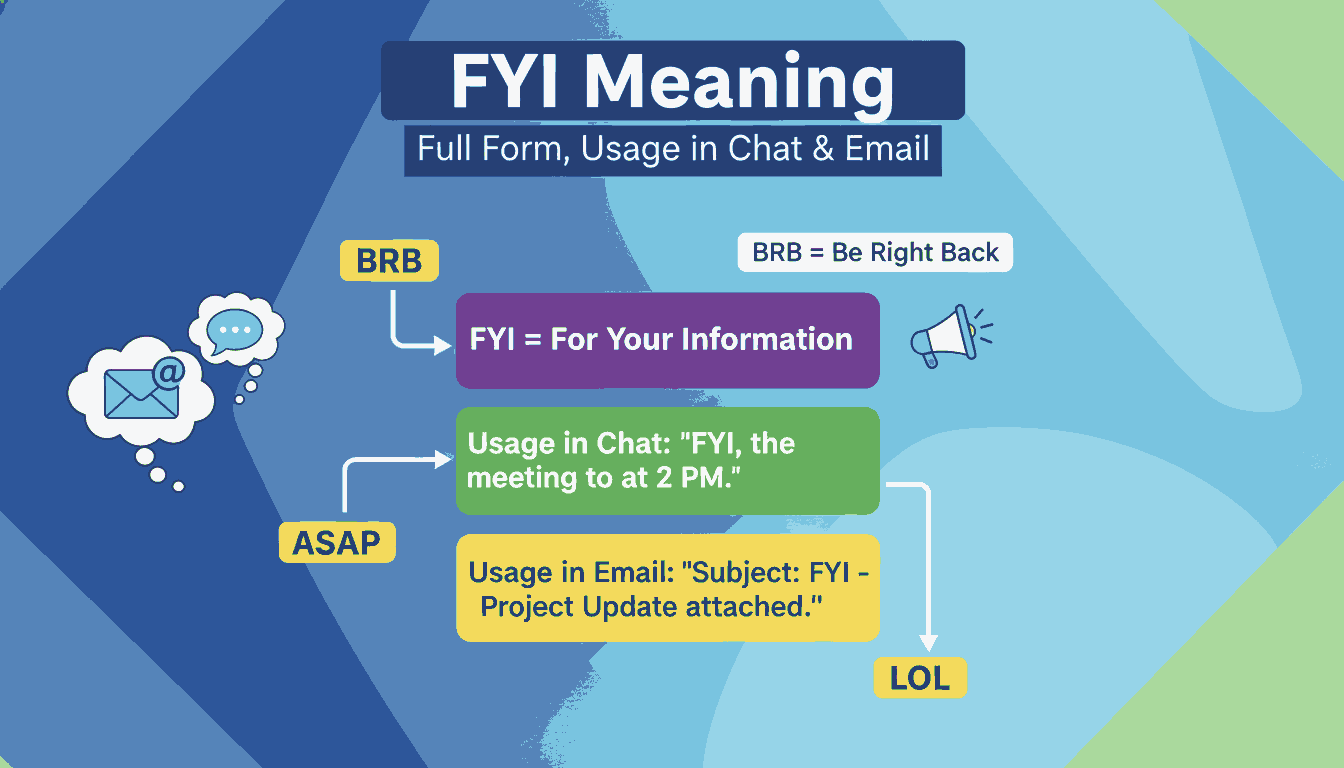
FYI means “For Your Information.” It is commonly used in chats, emails, and professional communication to share information without expecting an immediate response or action.
The purpose of FYI is simple: to inform someone about something they should know.
FYI Full Form Explained
The full form of FYI is For Your Information. It is used when the sender wants to pass along useful or relevant details.
In most cases, FYI is neutral in tone. It does not sound demanding or urgent, which makes it suitable for both casual and professional communication.
FYI Meaning in Chat
In chat conversations, FYI is used to quickly share updates, facts, or reminders. It helps keep messages short while still being clear.
For example, instead of writing a long sentence, people simply add FYI to highlight important information.
Examples:
- “FYI, that website is not working.”
- “Just FYI, I already completed the task.”
In chat, it often sounds casual but still informative.
FYI Full Form in Mail
In emails, FYI is widely used in professional settings. It is often added to:
- Share updates
- Forward information
- Keep someone in the loop
For example:
- “FYI, I have attached the latest report.”
- “Sharing this for your reference, FYI.”
In email communication, FYI helps maintain clarity without sounding forceful. It tells the receiver that the message is for awareness, not necessarily for action.
When to Use FYI
FYI is best used when you want to inform someone without asking them to do anything immediately.
Common situations include:
- Sharing updates or news
- Sending reference material
- Giving reminders
- Forwarding emails
Using FYI correctly helps avoid confusion about whether action is required.
When Not to Use FYI
FYI should be avoided in situations where:
- Immediate action is required
- Instructions need to be followed
- The message is urgent
In such cases, direct language is more effective than FYI.
FYI Usage Chart
| Situation | Example | Purpose |
| Sharing updates | “FYI, the deadline is tomorrow.” | Inform only |
| Sending documents | “FYI, report attached.” | For reference |
| Casual chat | “FYI, I won’t be available. | Quick update |
| Email forwarding | “FYI, see the below email.” | Keep informed |
What is FYA’s Meaning in Chat?
FYA stands for “For Your Action.” It is often used alongside FYI but has a different purpose.
While FYI is used for information only, FYA indicates that the receiver needs to take action.
Example:
- “Please review the document, FYA.”
This makes FYA more direct and task-oriented compared to FYI.
Difference Between FYI and FYA
| Aspect | FYI (For Your Information) | FYA (For Your Action) |
| Purpose | Inform Only | Request action |
| Tone | Neutral | Slightly directive |
| Usage | Updates, sharing info | Assigning tasks |
| Response Need | Not required | Required |
Benefits of Using FYI in Communication
Using FYI improves communication by making messages clear and concise. It helps:
- Avoid unnecessary explanations
- Keep messages short
- Clarify that no action is needed
- Maintain a professional tone
It is especially useful in fast-paced work environments where quick updates are common.
Common Mistakes When Using FYI
Some people misuse FYI, which can confuse. Avoid these mistakes:
- Using FYI when action is required
- Overusing FYI in every message
- Adding FYI without clear information
To use it effectively, ensure the message serves only as information.
Similar Abbreviations to FYI
Here are some related terms used in chats and emails:
- ASAP – As Soon As Possible
- TBH means – To Be Honest
- BTW – By The Way
- TIA Full Form – Thanks in Advance
- IMO – In My Opinion
- FYR – For Your Reference
- TIA Full Form in Chat – Thanks in Advance
These abbreviations, like FYI, help make communication faster and clearer.
Final Thoughts
FYI stands for “For Your Information” and is widely used in both chat and email communication. It helps share updates without expecting immediate action, making conversations more efficient.
Understanding the difference between FYI and terms like FYA ensures that your message is clear and appropriate for the situation.
