
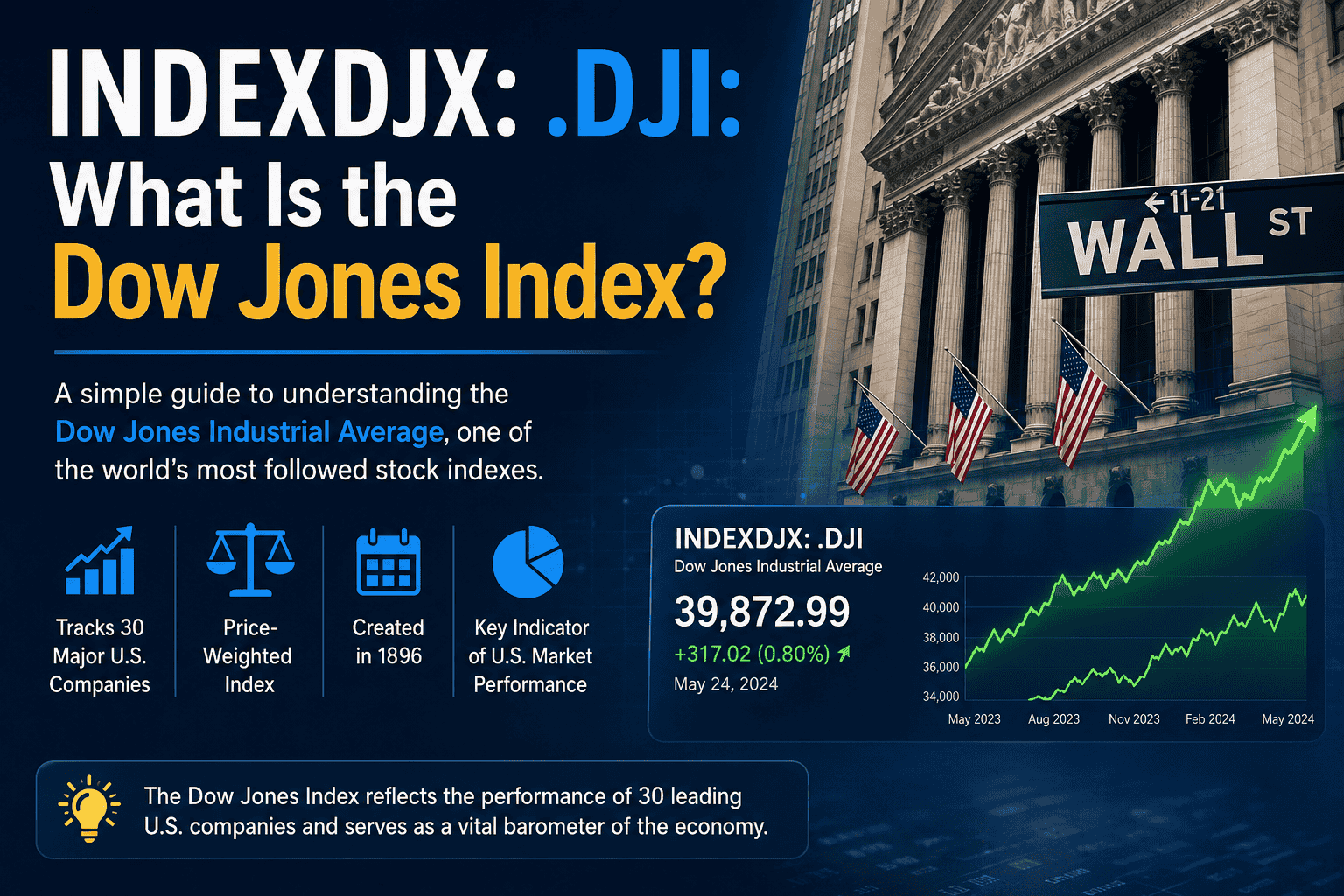
If you have searched for INDEXDJX: .DJI, you may have noticed that it looks more like a technical code than a stock symbol. In fact, INDEXDJX: .DJI is the identifier used by Google Finance for the Dow Jones Industrial Average (DJIA), commonly called the Dow Jones Index or simply the Dow.
The Dow Jones Industrial Average tracks 30 prominent U.S. companies and is one of the world’s most widely followed stock market indexes. Unlike the S&P 500, the Dow is price-weighted, meaning companies with higher share prices have a greater effect on the index.
What Does INDEXDJX: .DJI Mean?
The term INDEXDJX: .DJI is a market-data identifier, not the ticker of an individual company.
- INDEXDJX identifies the index listing.
- .DJI identifies the Dow Jones Industrial Average.
- DJIA is another common abbreviation for the same index.
- Dow Jones and Dow are commonly used names for the index.
When you search for INDEXDJX: .DJI on Google Finance, you are looking at the value and performance of the Dow Jones Industrial Average, not the price of an individual stock.
What Is the Dow Jones Index?
The Dow Jones Industrial Average is a stock market index containing 30 major U.S. companies. It was created in 1896 and has become a widely recognized indicator of movements in large, established U.S. businesses.
The index includes companies from different areas of the economy, rather than focusing exclusively on industrial businesses. Its components can change when the committee responsible for the index determines that another company better represents the U.S. economy.
The Dow is useful for tracking market sentiment, but it should not be treated as a complete measure of the entire U.S. stock market because it includes only 30 companies.
How Is the Dow Jones Index Calculated?
One of the most important things to understand about INDEXDJX: .DJI is that the Dow is price-weighted.
The basic calculation is:
Dow Jones Index = Sum of the prices of all 30 stocks ÷ Dow Divisor
The Dow Divisor is adjusted when events such as stock splits or other index changes occur. This helps prevent these corporate actions from creating artificial jumps in the index.
Simple Calculation Example
Suppose a simplified index contained three stocks:
| Stock | Share Price |
| Company A | $100 |
| Company B | $150 |
| Company C | $200 |
| Total | $450 |
If the hypothetical Dow Divisor were 0.15:
Index = $450 ÷ 0.15
Index = 3,000
This example is only for understanding the calculation. The actual Dow uses 30 components and its official divisor.
Why Does a Higher-Priced Stock Have More Influence?
Because the Dow is price-weighted, a percentage move in a higher-priced stock generally has a greater effect on the index than the same percentage move in a lower-priced stock.
For example, assume two stocks move up by 10%:
- Stock A: $50 → $55 = $5 increase
- Stock B: $500 → $550 = $50 increase
Both gained 10%, but Stock B added $45 more to the combined share-price total.
This difference matters between the Dow Jones Index and market-capitalization-weighted indexes such as the S&P 500.
Dow Jones Index vs. S&P 500
The Dow and S&P 500 are both major U.S. stock indexes, but they use different methodologies.
| Feature | Dow Jones | S&P 500 |
| Common name | Dow / DJIA | S&P 500 |
| Number of companies | 30 | About 500 |
| Weighting | Price-weighted | Market-cap weighted |
| Focus | Large, established U.S. companies | Broad large-cap U.S. market |
| Main symbol | .DJI | .INX |
The Dow provides a focused snapshot of 30 major U.S. companies, while the S&P 500 offers broader exposure to large U.S. businesses.
Why Is the Dow Jones Index Important?
Investors, financial institutions, analysts, and news organizations follow the Dow closely because it provides a quick indication of how several major U.S. companies are performing.
A rising Dow may indicate positive sentiment toward its constituent companies, while a falling Dow can reflect concerns about corporate earnings, interest rates, economic conditions, or geopolitical developments.
However, view the Dow alongside other indicators, not as the only measure of market performance.
What Can Cause the Dow Jones to Rise or Fall?
Several factors can influence INDEXDJX: .DJI, including:
Company Earnings
Better-than-expected earnings can support individual Dow components and potentially push the index higher. Weak earnings or reduced forecasts can have the opposite effect.
Interest Rates
Changes in U.S. interest-rate expectations can affect stock valuations. Higher borrowing costs can put pressure on companies and investor sentiment.
Economic Data
Reports covering employment, inflation, consumer spending, and economic growth can influence expectations about the U.S. economy and monetary policy.
Global Events
Geopolitical developments, trade policies, energy prices, and international economic conditions can also affect the Dow.
What Is the Difference Between INDEXDJX: .DJI and DowJones Index?
There is essentially no difference in the underlying index.
INDEXDJX: .DJI is a platform-specific identifier for the Dow Jones Industrial Average. Dow Jones Index, DJIA, and Dow are commonly used names for the same benchmark.
The important distinction is that the Dow Jones Industrial Average is an index, not an individual company or ordinary stock.
What Does “Dowjones Index” Mean?
Dowjones index is simply another way people search for or refer to the Dow Jones Industrial Average. Search engines and financial platforms may display the official name as Dow Jones Industrial Average, while users may type variations such as “dowjones index,” “Dow Jones Index,” or “DJI.”
These terms generally point to the same market benchmark.
What About the “Dizone Index”?
The phrase “dizone index” is sometimes used as a search variation when people are looking for information about the Dow Jones Index. It is not the official name of the Dow Jones Industrial Average.
If you encounter “dizone index” while searching for market information, verify that the result refers to the Dow Jones Industrial Average (DJIA) or INDEXDJX:.DJI before relying on the information.
Can You Invest Directly in INDEXDJX: .DJI?
You cannot purchase the Dow Jones index itself like an individual company’s stock.
Instead, investors can obtain exposure to the Dow through financial products designed to track the index, such as exchange-traded funds (ETFs). Evaluate the specific product, fees, risks, and tracking performance before investing.
How to Read INDEXDJX: .DJI
When checking the Dow Jones on a financial platform, pay attention to more than its current level.
Useful figures include:
- Current index value: Shows the latest reported level.
- Daily change: Shows how much the index has moved during the session.
- Percentage change: Makes the daily movement easier to compare.
- 52-week high and low: Shows the recent trading range.
- Historical chart: Helps identify longer-term trends.
For example, if the Dow moves from 50,000 to 50,500:
Point change = 50,500 − 50,000 = 500 points
Percentage change = (500 ÷ 50,000) × 100 = 1%
So, the Dow increased by 500 points, or 1%.
Frequently Asked Questions
Is INDEXDJX: .DJI the Dow Jones?
Yes. INDEXDJX: .DJI is the Google Finance identifier for the Dow Jones Industrial Average.
How many companies are in the Dow Jones Index?
The Dow Jones Industrial Average contains 30 companies.
Is the Dow Jones market-cap weighted?
No. The Dow is price-weighted, meaning its components’ share prices determine their influence on the index.
Is Dow Jones the same as DJIA?
Yes, .DJIA stands for the Dow Jones Industrial Average, commonly called the Dow Jones or simply the Dow.
Is INDEXDJX: .DJI a stock?
No. It is an index identifier. It represents the Dow Jones Industrial Average, not an individual company’s stock.
Final Takeaway
INDEXDJX: .DJI is the identifier used to display the Dow Jones Industrial Average, one of the most closely followed U.S. stock market indexes. The Dow tracks 30 prominent U.S. companies and uses a price-weighted methodology.
Whether you search for INDEXDJX: .DJI, Dow Jones Index, dowjones index, or encounter the less accurate term dizone index, the key is to identify the Dow Jones Industrial Average and understand how its price-weighted structure works before interpreting its movements.
