
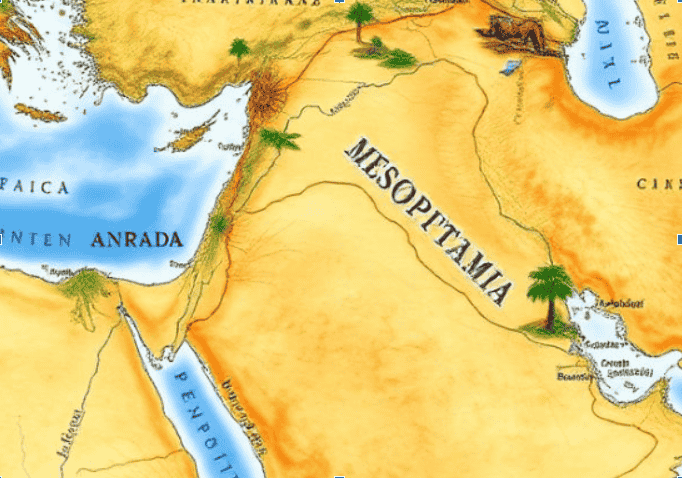
When studying ancient history, Mesopotamia on the map is one of the most searched topics and for good reason. Mesopotamia is widely known as the birthplace of civilization, where writing, cities, laws, and empires first emerged. Understanding its location on the map helps us better understand how geography shaped early human development.
This guide explores Mesopotamia on a map, its global position, its civilization, its social structure, and its powerful Mesopotamian empires.
Mesopotamia on Map: Where Was It Located?
To understand Mesopotamia on map, we must start with its geographical meaning. The word Mesopotamia comes from the Greek and means “land between two rivers.”
These two rivers were:
- Tigris River
- Euphrates River
Mesopotamia was located in Western Asia, mostly within the present-day:
- Iraq
- Parts of Syria
- Southeastern Turkey
- Kuwait
On a modern world map, Mesopotamia lies in the Middle East, between the Mediterranean Sea and the Persian Gulf.
Map of Mesopotamia and Its Natural Boundaries
Looking at a map of Mesopotamia, the region appears as a fertile plain surrounded by harsh landscapes.
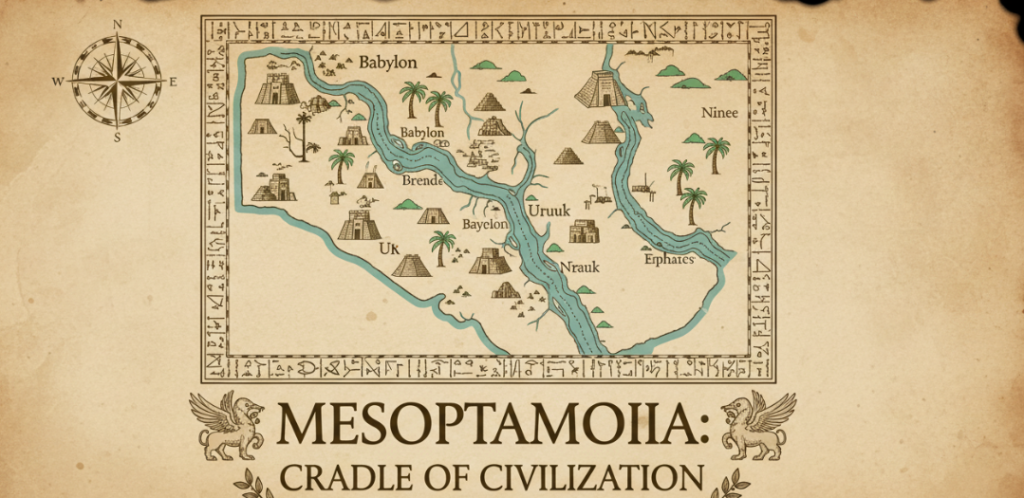
Natural Boundaries:
- North: Taurus Mountains
- East: Zagros Mountains
- South: Persian Gulf
- West: Syrian Desert
This fertile area, fed by river floods, is why Mesopotamia supported agriculture and permanent settlements earlier than most regions.
Mesopotamia on World Map: Global Importance
When placed on a Mesopotamian world map, its strategic position becomes clear. Mesopotamia connected:
- Asia
- Africa
- Europe
Because of this location, it became a center of trade, culture, and innovation. Goods, ideas, and technologies spread from Mesopotamia to neighboring civilizations, such as Egypt and the Indus Valley.
Where Was Ancient Mesopotamia Located Exactly?
Where was ancient Mesopotamia?
Ancient Mesopotamia was divided into two main regions:
- Upper Mesopotamia (Assyria) – Northern region
- Lower Mesopotamia (Babylonia) – Southern region
Lower Mesopotamia later included:
- Sumer
- Akkad
These regions appear clearly when studying Mesopotamia on map with historical boundaries.
Mesopotamia Civilization: The First Urban Society
The Mesopotamian civilization is considered the world’s earliest complex civilization, dating back to around 3500 BCE.
Major Contributions:
- Invention of writing (cuneiform)
- Development of laws (Code of Hammurabi)
- Creation of cities like Uruk and Babylon
- Advances in mathematics and astronomy
The fertile land shown on the map of Mesopotamia enabled farming, which led to population growth and the development of urban life.
Social Structure in Mesopotamia
The social structure in Mesopotamia was strictly hierarchical. Each class had clear roles.
Main Social Classes:
- Kings and Nobles – Rulers and administrators
- Priests – Religious leaders and scholars
- Merchants and Artisans – Traders and skilled workers
- Farmers – Agricultural backbone
- Slaves – Prisoners or debtors
Social position was often inherited, though trade allowed limited mobility.
Chart: Social Structure in Mesopotamia
| Social Class | Role in Society | Living Conditions |
| King & Nobles | Governed cities and armies | Luxurious palaces |
| Priests | Managed temples and rituals | Comfortable |
| Merchants & Artisans | Trade and craftsmanship | Stable |
| Farmers | Grew crops and food | Modest |
| Slaves | Manual labor | Poor |
Mesopotamian Empires: Rise and Fall
Several powerful Mesopotamian empires ruled the region for thousands of years. Each expanded across the land, as seen in Mesopotamia on the map.
Major Mesopotamian Empires:
- Sumerian Empire – First city-states
- Akkadian Empire – First united empire
- Babylonian Empire – Famous for laws
- Assyrian Empire – Military power
- Neo-Babylonian Empire – Cultural revival
Each empire controlled key trade routes visible on the Mesopotamian world map.
How Geography Shaped the Civilization of Mesopotamia
The location of Mesopotamia on the map directly influenced its development.
Advantages:
- Fertile soil from river floods
- Easy transportation via rivers
- Trade connections
Challenges:
- Unpredictable flooding
- Lack of natural defenses
These challenges led to innovation, laws, and strong governance.
Religious Beliefs and Daily Life in Mesopotamia
The Mesopotamians believed natural forces were controlled by gods. Temples called ziggurats dominated city centers and are easily marked on historical maps of Mesopotamia.
Daily life included:
- Farming
- Trading
- Writing on clay tablets
- Religious ceremonies
Religion deeply influenced laws, politics, and social structure.
Why Mesopotamia on Map Still Matters Today
Studying Mesopotamia on a map helps us understand:
- The origin of cities
- The foundation of modern laws
- Early economic systems
- Human adaptation to the environment
Many modern concepts, from calendars to the legal system,s trace back to this region.
Conclusion
Understanding Mesopotamia on map is essential to understanding human history itself. Positioned between the Tigris and Euphrates rivers, Mesopotamia became the world’s first great civilization. Its geography shaped its society, economy, and empires, leaving a legacy that continues to influence the modern world.
By exploring the map of Mesopotamia, its social structure, civilization, and empires, we gain a clearer picture of where civilization truly began. Visit Seotoolzz for more related information.
